SketchBloom: Training-Free Vector Sketch Outpainting with Stroke-Level Style Control
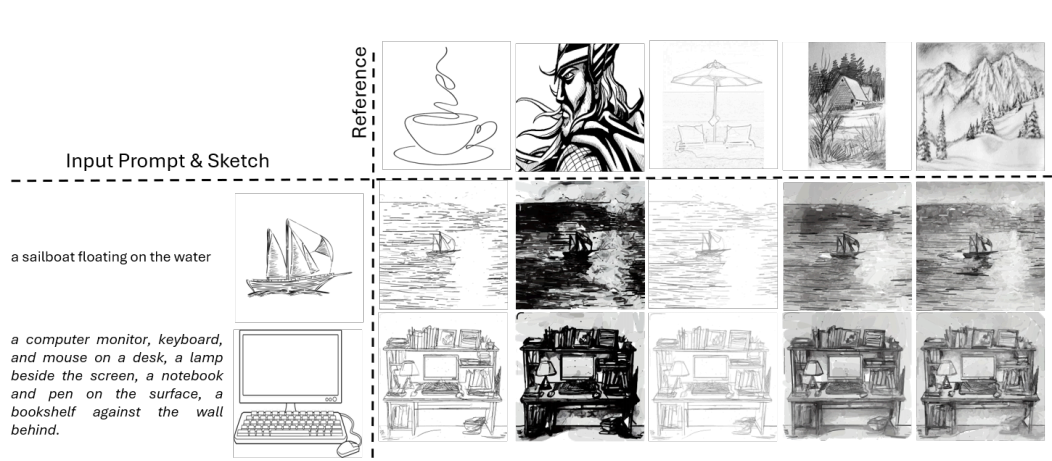
Style-guided vector sketch outpainting with SketchBloom.
Given an input sketch, a text prompt, and a reference style image, SketchBloom extends the scene while transferring the reference stroke vocabulary and producing an editable SVG.
Abstract
SketchBloom is a training-free framework for text-guided vector sketch outpainting with stroke-level style control. Given a sparse input sketch, a text prompt, and an optional reference style image, SketchBloom extends the sketch beyond its original boundary while preserving the sketch domain.
The method transfers the reference style’s stroke width, color, and texture distribution through adaptive latent blending. It then converts the result into a resolution-independent SVG composed of optimized Bézier strokes.
What SketchBloom Does
SketchBloom combines three capabilities in one training-free pipeline:
- Sketch outpainting: extends a sparse input sketch using a text prompt.
- Reference-guided style control: transfers stroke-level visual identity from a reference image.
- Editable SVG generation: produces scalable Bézier strokes rather than fixed raster pixels.
Method Overview
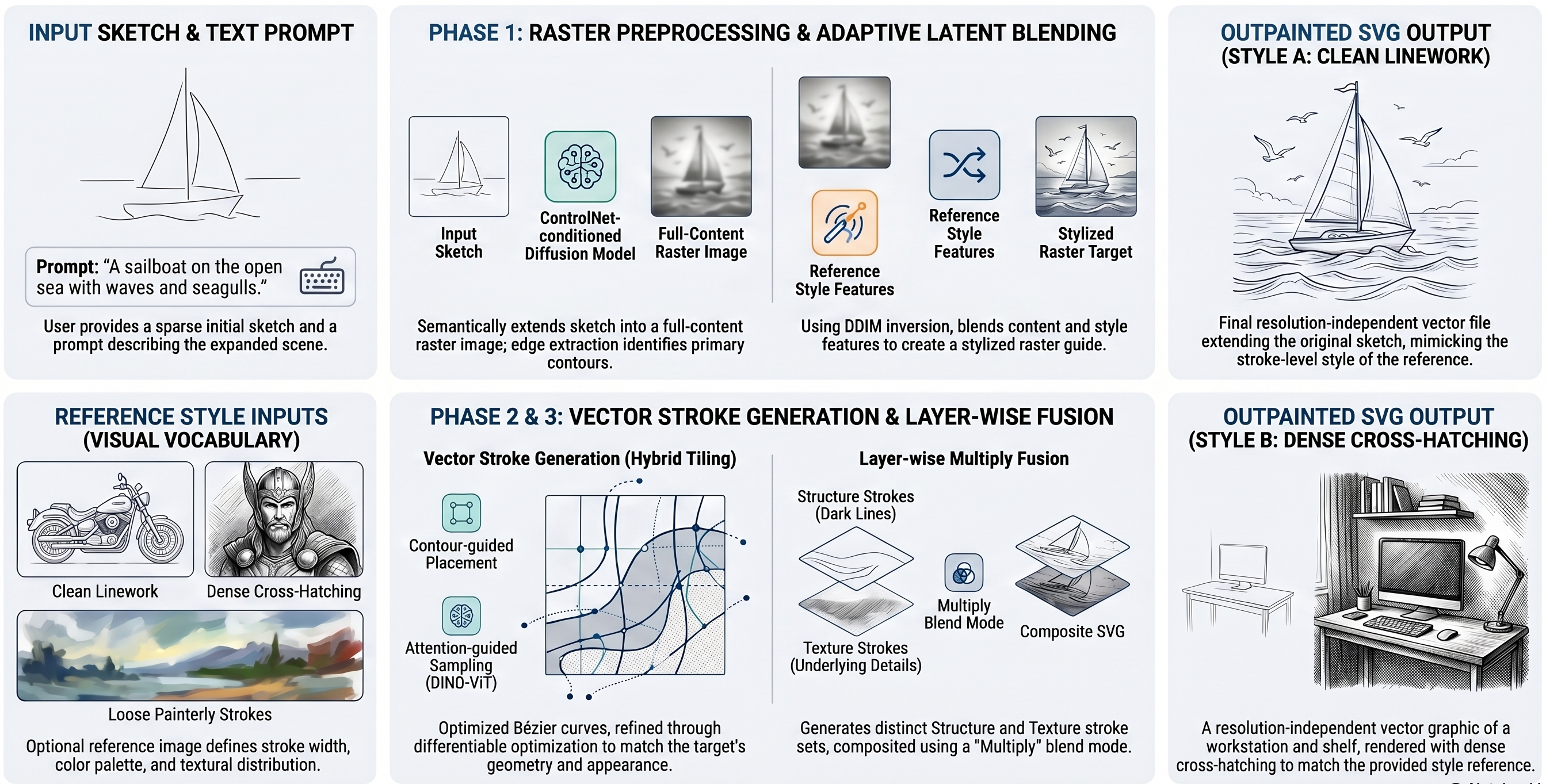
Overview of SketchBloom.
The pipeline first produces a stylized raster target, initializes and optimizes Bézier strokes, and finally fuses structure and texture stroke layers into an editable SVG.
Stage 1: Raster preprocessing and adaptive latent blending
SketchBloom first uses a ControlNet-conditioned diffusion model to semantically extend the input sketch into a full-content raster image. It then extracts contours and applies reference-guided style transfer through DDIM inversion, AdaIN initialization, and adaptive latent blending.
This stage produces a stylized raster target that guides the later vector optimization stage.
Stage 2: Differentiable stroke initialization and optimization
SketchBloom initializes Bézier strokes through a hybrid tiling strategy. Contour-guided placement preserves important structural lines, while attention-guided sampling improves coverage in semantically important regions.
The system then optimizes two stroke sets separately:
- Structure strokes: preserve dark contour geometry.
- Texture strokes: capture shading, hatching, and loose stylistic detail.
Stage 3: Layer-wise vector fusion
The final SVG is produced by compositing the structure and texture stroke sets using a multiply-blend layering scheme. This preserves dominant contour lines while retaining style-specific texture and shading.
Qualitative Results
SketchBloom produces coherent vector outpainting across diverse subjects, scene prompts, and reference styles. The examples include clean linework, dense cross-hatching, graphite shading, and loose painterly strokes.
Cross-style Outpainting
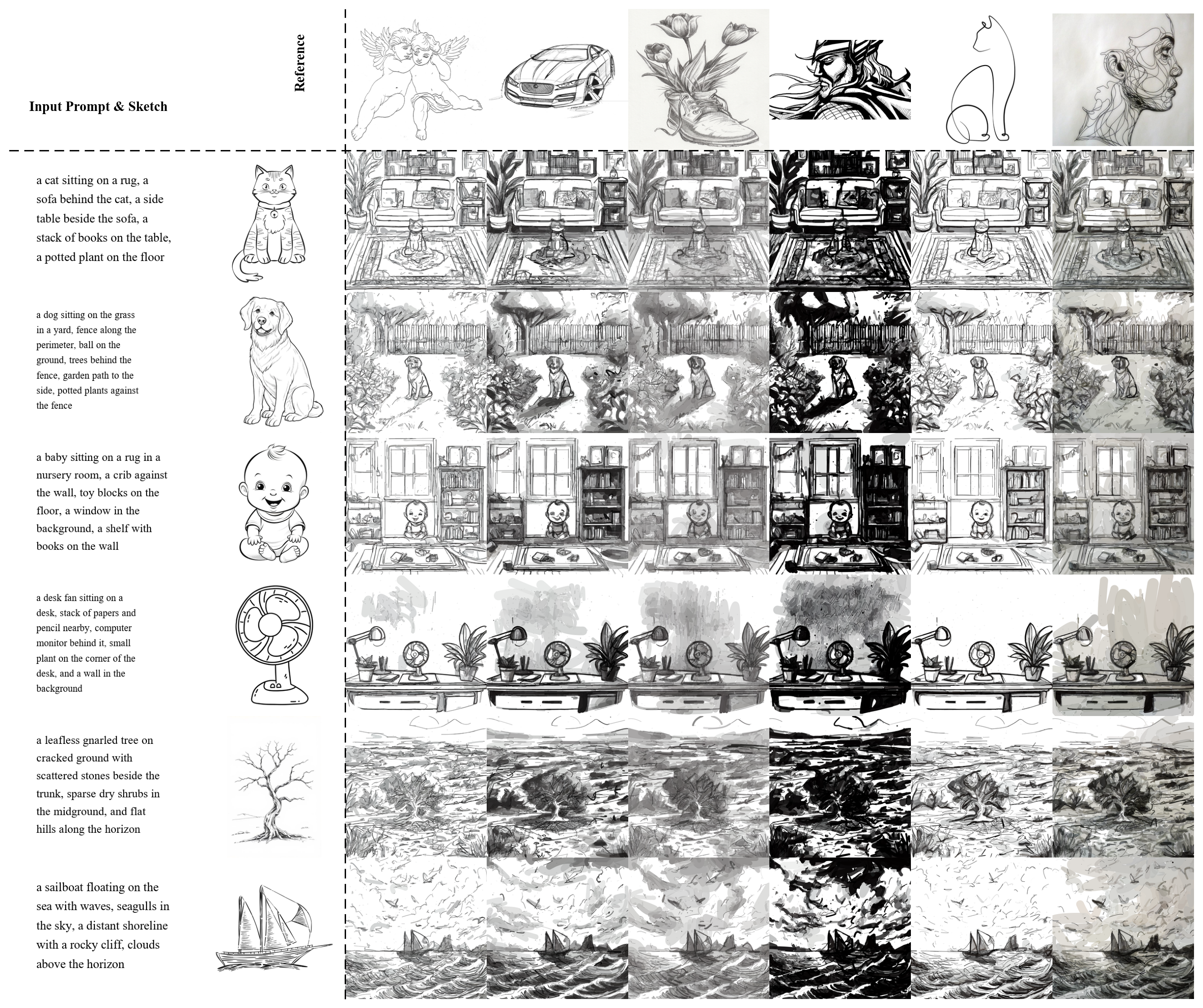
Cross-style qualitative results.
Rows show different input sketches and scene prompts, while columns show outputs conditioned on different reference styles.
Comparison with Baselines
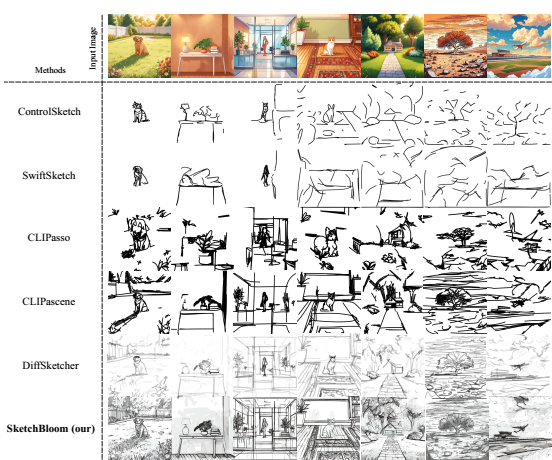
Comparison with existing methods.
SketchBloom better preserves object boundaries, perspective, and scene-level structure while maintaining an editable vector representation.
Quantitative Results
We evaluate sketch vectorization quality by providing all methods with the same outpainted content image. Higher values are better for Aesthetic, DINO, and Edge F1, while lower values are better for DreamSim.
| Method | Aesthetic ↑ | DINO ↑ | DreamSim ↓ | Edge F1 ↑ |
|---|---|---|---|---|
| CLIPasso | 4.1690 | 0.2064 | 0.7256 | 0.5262 |
| CLIPascene | 4.3904 | 0.2022 | 0.7024 | 0.5797 |
| SwiftSketch | 3.9784 | 0.1566 | 0.8305 | 0.3139 |
| ControlSketch | 4.1493 | 0.1470 | 0.7960 | 0.3299 |
| DiffSketcher (adapted) | 4.8020 | 0.3760 | 0.5351 | 0.8325 |
| SketchBloom (Ours) | 5.2186 | 0.5053 | 0.4983 | 0.8866 |
SketchBloom achieves the strongest overall result across all four reported metrics, indicating improved visual quality, semantic consistency, perceptual similarity, and contour preservation.
User Study
The perceptual study involved 33 participants. Participants compared SketchBloom with CLIPascene and an adapted DiffSketcher under Perceptual Quality, Content Preservation, and Structural Coherence.
| Compared Method | Perceptual Quality ↑ | Content Preservation ↑ | Structural Coherence ↑ |
|---|---|---|---|
| CLIPascene | 97.2% | 96.8% | 96.5% |
| DiffSketcher (adapted) | 87.4% | 84.9% | 83.5% |
Citation
@misc{sketchbloom2026, title={SketchBloom: Training-Free Vector Sketch Outpainting with Stroke-Level Style Control}, author={Quang-Thinh Nguyen and Duy-Khang Do and Tam V. Nguyen and Minh-Triet Tran and Trung-Nghia Le}, year={2026}}